Security & Crypto
PBKDF2-HMAC Key-Derivation IP Core
Hardware PBKDF2-HMAC-SHA-256/512 key derivation for SSD/eMMC key establishment.
Overview
A hardware PBKDF2-HMAC engine that turns a user password into a cryptographic key with two defenses — a per-record salt and a tunable iteration count (key stretching). It is built for storage controllers: deriving the Key-Encryption-Key (KEK) that unlocks an SSD/eMMC, host authentication, and preparing data-encryption keys.
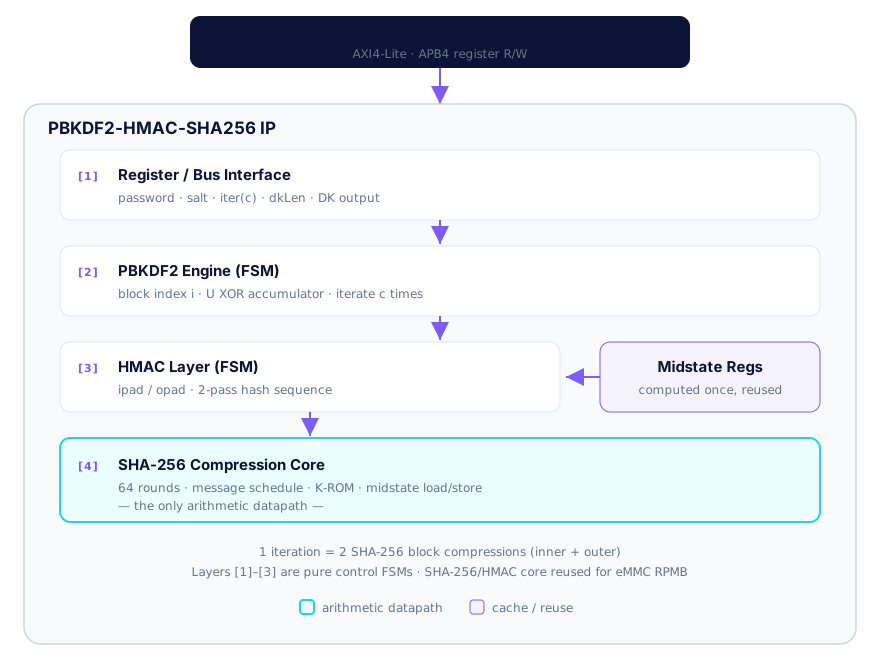
The design decomposes into three layers, but the only arithmetic datapath is a single SHA-256 compression core — the HMAC and PBKDF2 layers are pure control FSMs. A midstate cache pre-computes the password-key padding once and reuses it across every iteration, so one iteration costs just two SHA-256 block compressions (roughly a 2× saving). The same SHA-256/HMAC core is reused for eMMC RPMB authentication.
Block Diagram
Parametric specification
| Role | SSD/eMMC controller key derivation (KEK), host auth, data-key prep |
|---|---|
| Standards | RFC 8018 (PBKDF2), RFC 2104 (HMAC), FIPS 180-4 (SHA-2), NIST SP 800-132 |
| Algorithm | PBKDF2-HMAC-SHA-256 (SHA-512 option) |
| PRF | HMAC-SHA-256 / HMAC-SHA-512 |
| Iteration count (work factor) | tunable, 32-bit (e.g. 600,000 per OWASP 2023) |
| Derived key length | up to 64 B (multi-block for larger) |
| Interface | AXI4-Lite slave (32-bit); APB4 via bridge; IRQ or polling |
| Key optimization | midstate cache → 1 iteration = 2 SHA-256 compressions |
| Clock | 100–150 MHz (Arria II GX) |
| Resource | ≈3,000–5,000 LE on EP2AGX260 (≈2%) |
| Verification | layered KAT: SHA-256, HMAC (RFC 4231), PBKDF2 vectors |
| Implementation | pure RTL (vendor-primitive-free); iverilog + Quartus |
| Status | Design spec Rev 1.1, RTL deliverable; FPGA characterization at integration |
Performance
Variants
PBKDF2-SHA256
Default — HMAC-SHA-256 PRF, 32 B hash, mainstream KEK derivation.
PBKDF2-SHA512
Higher-strength option — HMAC-SHA-512 PRF, 64 B hash.
Deliverables
- Synthesizable Verilog RTL (sha256_core, hmac_engine, pbkdf2_engine, AXI4-Lite regs, top) — pure RTL, vendor-primitive-free
- AXI4-Lite register map + bare-metal C driver (polling & interrupt)
- Layered KAT testbench (SHA-256, HMAC RFC 4231, PBKDF2 vectors) + iverilog flow
- Quartus synthesis scripts and design specification Rev 1.1 (under NDA)
Supported Devices
Targets / verified platforms. ASIC process numbers are characterized at integration.
Full secure-storage datapath from one vendor: PBKDF2 derives the KEK and unwraps the media key (MEK), AES-256-XTS encrypts the sectors (IEEE 1619), and the shared SHA-256/HMAC core authenticates eMMC RPMB (JEDEC) — saving area and verification effort.
Resource and timing figures are estimates on Arria II GX (EP2AGX260); final numbers are characterized at integration. The detailed register map, C driver and test vectors are provided under NDA.
Documents
Full datasheet, integration guide and evaluation files are available under NDA. Request access below — we reply within one business day.
Request DatasheetApplications
Request Quote
Request a Quote or Evaluation
Tell us about your project. Fields marked * are required. We respond within one business day.